End of Tenancy Cleaning Checklist, Room by Room
A room by room end of tenancy cleaning order, the way a professional works it, plus the specific spots a checkout inspector opens first.
Published by Jerimiah, owner of J&BROS Cleaning Last updated 16 August 2026 5 min read
In short
Work the property empty, top to bottom, and start the oven soaking before you touch anything else. Checkout inspectors go to the same places every time: oven door glass, extractor filters, limescale on shower screens and heads, window tracks, sealant lines, and the floor behind the fridge and washing machine. Leave the floors until last.
This is the procedure, not the law. If you want to know what a landlord can and cannot charge you for, and what happens if you disagree, read what actually affects your deposit instead. What follows is the order a professional end of tenancy clean works a flat in, and the specific places an inspector opens.
Two rules underneath all of it. Work the property empty, because you cannot clean around a sofa. And work top to bottom in every room, because dust falls.
Before you start
Empty it completely
Get everything out. Wardrobes empty, drawers out, cupboards bare, bins gone, nothing under the bed. Then walk the flat once with a bin bag and a pen and note what needs a repair rather than a clean: a blown bulb, a missing cupboard door buffer, a picture hook. Those are quick and they are itemised separately.
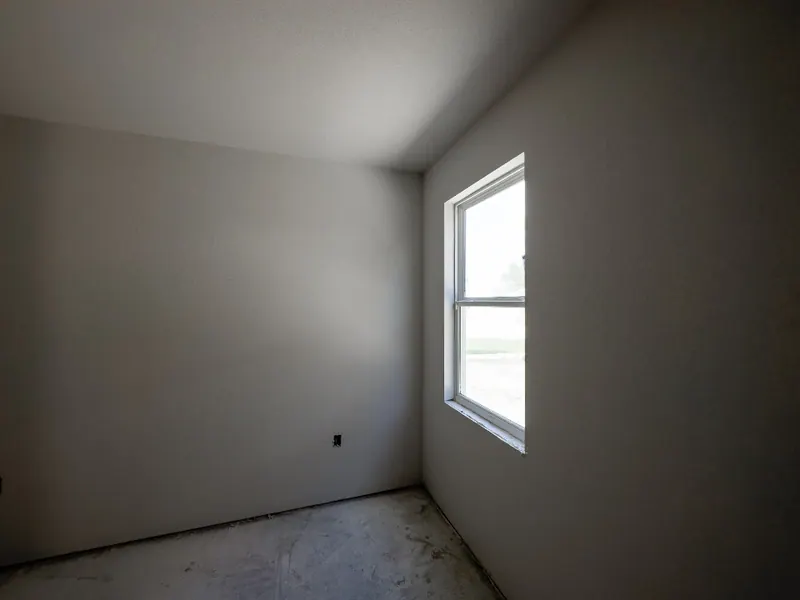
This is the state everything below assumes: nothing left to clean around.
Matt Bango · CC0Fridge and freezer off now
Turn the fridge and freezer off now and leave both doors propped open on a towel. A freezer that is still defrosting at four in the afternoon will ruin your schedule.
The oven, started first
Shelves out and soaking
The oven is the longest single job in the flat, so it goes on before anything else. Take the shelves, the grill pan and the runners out and put them in the bath on an old towel with hot water and a degreaser. Leave them.
Enamel or catalytic
Before you spray the cavity, look at the side walls. If they are smooth enamel, a caustic oven cleaner is fine. If they are rough and matt, they are catalytic liners.
The door glass
The door glass is the part that gets flagged. Grease works its way between the panes and no amount of wiping the outside touches it. On most ovens the door lifts off once the hinge clips are up, and the inner pane comes out of the frame. Photograph the assembly first.
The kitchen
Kitchen
- Extractor filter. Slide the metal mesh out of the hood and put it through the dishwasher on a low temperature short cycle. AEG rates a reusable filter at about 40 hours of cooking, and most tenants have never taken it out at all.
- Hood canopy and the wall behind the hob, degreased, including the strip of ceiling directly above.
- Cupboard interiors, all of them, plus the tops of the wall units and the greasy top edge of the doors.
- Behind and under the fridge, the washing machine and the freestanding cooker, if they roll or slide out without force.
- Fridge seals, which hold a black line of mould in the folds. A cloth wrapped over an old toothbrush handle gets into them.
- Washing machine drawer and door seal, both removable, both usually grim. Run an empty hot wash afterwards.
- Sink, plughole and tap base, descaled rather than polished.
44% of accidental fires
Why grease matters
A saturated filter is a safety item as well as a cleaning one: cooking appliances were behind 44% of accidental dwelling fires in England in 2024-25.
Integrated appliances in a new build
In a Canary Wharf or Isle of Dogs new build with integrated appliances, the fridge and washer sit behind fitted doors and often cannot be moved. Clean what you can reach and do not lever anything out of its housing. Plenty of those same flats run as short lets between tenancies, capped by the 90 night limit on London short lets, and a changeover clean is a shorter, more frequent version of this list.
The bathroom
Why it takes longer here
London water is hard. Not some of it: Thames Water’s own position is that every part of its supply area gets hard water, and the top band on its scale, very hard, is anything past 300 mg/l of calcium carbonate. That is the whole reason a bathroom takes longer here than the same bathroom would in Manchester.
Bathroom
- Shower head, unscrewed and left in descaler, or bagged up around the fitting if it will not come off.
- Shower screen, both faces, descaled and then dried with a squeegee or it dries cloudy again.
- The screen runner and the bottom seal strip, which collect a grey sludge.
- Sealant lines around the bath, tray and basin. Discoloured silicone that will not come back is a repair item, not a cleaning failure, but the surface film is yours.
- Tap bases, the overflow and the plug chain, all scale traps.
- Toilet: under the rim, behind the pan, the hinge caps, and the floor around the base.
- Extractor grille, unclipped and washed.
Bedrooms, living room, hallway
Faster rooms, and mostly dust. Light fittings and shades, the tops of doors, door frames, skirting, radiators including behind them, switch plates, plug sockets, and the tops of picture rails in the older conversions around Whitechapel and Limehouse. Mirrors and glass go last in the room.
Wardrobe and cupboard interiors get wiped out, and internal windows and any glazed doors get done properly on both sides.
Windows, tracks and sills
Glass is easy and the tracks are not. The runner channel on a sliding balcony door in a riverside block, or the drainage slots along the bottom of a casement frame, fill with a black paste of grit and rain. Vacuum the channel with a crevice tool first, then work a damp cloth through it with a blunt knife or an old toothbrush. Do the frames, the rubber gaskets and the sills, then the glass.
Floors last
Vacuum everything, including the edges and under where the furniture stood, then mop hard floors. Carpets are the last thing that happens in the property, after every other room is finished.
The final walk
Do it with a torch, at a low angle, in the evening if you can. Raking light across a worktop, a shower screen or a skirting board shows smears and film that overhead light hides completely. Check inside the oven door glass, run a finger along the top edge of a door, and look up at the ceiling above the hob.
Then photograph every room, dated, from the same angles you used on the day you moved in.
The numbers, and where they come from
- Extractor filter interval
- AEG tells owners to clean a reusable cooker hood grease filter after about 40 hours of use, washing it in a dishwasher on a low temperature and a short cycle.
- Source
- Catalytic liners
- AEG states plainly: do not clean the catalytic surface with oven sprays, abrasive cleaning agents, soap or other cleaning agents, because it will damage the catalytic surface.
- Source
- London water is hard
- Thames Water says all the water in its region is hard, and rates anything above 300 mg/l of calcium carbonate as very hard on its own scale.
- Source
- Why grease matters
- Cooking appliances were the largest specified ignition category for accidental dwelling fires in England in 2024-25, at 44%, which is why landlords care about a greased-up hood.
- Source
Common advice that is wrong
- false
“Bleach and a good hoover will get a flat through a checkout.”
Bleach is an oxidiser: it whitens and disinfects. Limescale wants an acid, baked grease wants an alkaline degreaser, and acid poured into bleach gives off chlorine.
Bleach is an oxidising agent, which is how it lifts stains and kills germs. Limescale is calcium carbonate, insoluble in water, so it has to be reacted away with an acid. Baked grease is fat, and alkaline degreasers break it down by saponifying it. Those sit at opposite ends of the pH scale, so one spray cannot do both rooms. Never mix them either. Adding an acid to a bleach based cleaner releases chlorine gas.
Source: edu.rsc.org
- false
“Caustic oven cleaner is safe on any oven.”
Run a finger over the side and back walls first. A catalytic liner feels like sandpaper, not enamel. AEG says oven sprays, abrasives and soap damage it.
AEG's instruction for its catalytic liners is a list of things to keep off them: no oven spray, no abrasive, no soap and no other cleaning agent either, because each of those damages the liner. The lining feels like sandpaper, so run a finger over the side and back walls before you spray anything. If it is rough, clean the door, the cavity floor and the shelves by hand and let the catalytic cycle handle the rest. If the oven has a pyrolytic programme, use that instead.
Source: support.aeg.co.uk
- true but risky
“The oven can wait until the last morning.”
AEG's self clean cycles run one to three hours and the oven has to go cold before the ash can be wiped out, so treat it as a half day job.
It can wait, if the oven is nearly clean already. After two years it usually is not. AEG's pyrolytic programmes take one hour, an hour and a half, or three hours depending on how dirty the cavity is, and you cannot wipe the residue out until the oven has cooled. Carbon on the door glass and the shelves wants a long soak rather than hard scrubbing. The last morning is also when the van arrives and the keys are due back.
Source: support.aeg.co.uk
- partly true
“Steam cleaning removes limescale.”
Steam softens soap film and grime, and the glass looks better straight after. The cloudiness returns as it dries unless a descaler follows.
Heat and moisture soften soap film, so a screen does look better straight after steaming. Scale is a different problem. Calcium carbonate is insoluble in water, and only comes away by reacting with an acid. Steam first if you like, then work a descaler over the glass, the taps and the shower head. Skip that step and the cloudiness comes back as the surface dries.
Source: edu.rsc.org
What we see on the job
There are six of us and we clean apartments, terraced houses and family homes across East London every week, so a move out is a familiar shape of job rather than a special event. We do not rush it and we do not leave a room half done. The one thing worth deciding before the day is supplies: if you would rather we brought products and equipment than used whatever has been left behind, we can, for a small extra charge. On an empty property that is usually the sensible choice, because the cupboards are bare by the time we arrive.
Common questions
What order should I clean a flat in at the end of a tenancy?
Empty it completely first, then start the oven soaking. After that work kitchen, bathroom, bedrooms, living room, hallway, and floors last. Within each room go top to bottom so dust falls onto surfaces you have not cleaned yet. Windows and their tracks fit in near the end, before the floors.
How do I clean between the two panes of oven door glass?
On most ovens the door lifts off once the hinge clips are flipped up, and the inner glass then slides or unscrews out of the frame. Take a photo before you start so you can reassemble it. If the door does not come apart on your model, do not force it, and note the marks are between the panes.
What gets missed most often in a bathroom?
The shower head, the sealant line where the bath or tray meets the wall, the underside of the toilet rim and the hinges of the seat, the extractor grille, and the shower screen runner. All five hold either scale or a grey film, and all five are checked.
Do I need to pull out the fridge and the washing machine?
If they move without force, yes. The floor and skirting behind them is a standard checkout look, and in a fitted kitchen the appliance normally slides forward on its feet. Do not drag anything across a vinyl or timber floor, and do not unplumb a washing machine to reach behind it.
How long does a full end of tenancy clean take?
For one person doing it properly, a studio or one bedroom flat is most of a day and a two bedroom is longer. The oven alone can absorb two hours of that. The realistic saving is not the money, it is knowing the order to work in so nothing gets cleaned twice.
If you would rather we did it
We are a small cleaning team working across Canary Wharf and East London.
End-of-Tenancy Cleaning
Agent-ready finish so you get your deposit back.
From £100
Deep Cleaning
Oven, behind furniture, limescale, skirting boards.
From £60
Who is behind this
J&BROS Cleaning is run by Jerimiah, who owns the business. We are a small cleaning team working across Canary Wharf and East London, and these guides are published under his name. More about us .
Cleaning in East London
Same-day quote · fixed price