Limescale and London Hard Water: What Actually Works
London water is hard, so scale returns fast. What removes limescale from shower glass, taps and shower heads, and which popular tips do nothing.
Published by Jerimiah, owner of J&BROS Cleaning Last updated 16 August 2026 5 min read
In short
Limescale is calcium carbonate, so only an acid dissolves it. Citric acid in warm water is the safest general choice, and shower head manufacturers recommend it. WD-40 contains no acid and only hides the deposit under an oily film. Thames Water classifies water above 300 mg/l as very hard and says all the water in its region is hard.
Limescale is calcium carbonate. It arrives dissolved in the tap water, and when that water evaporates or gets heated the mineral is left behind as a chalky crust on shower glass, chrome and spray nozzles. That single sentence explains why most internet cleaning advice either works or does nothing. Calcium carbonate dissolves in acid. If the tip involves an acid, it has a chance. If it does not, it is cosmetics.
200-300 mg/l
London water is hard
Thames Water calls that hard, anything above it very hard, and says all its region’s water is hard.
The Drinking Water Inspectorate confirms there is no legal limit on hardness in the UK, because it is a nuisance rather than a health risk. So a flat in Canary Wharf, Wapping or on the Isle of Dogs is not dealing with occasional spotting. It is dealing with a fresh deposit every time someone showers.
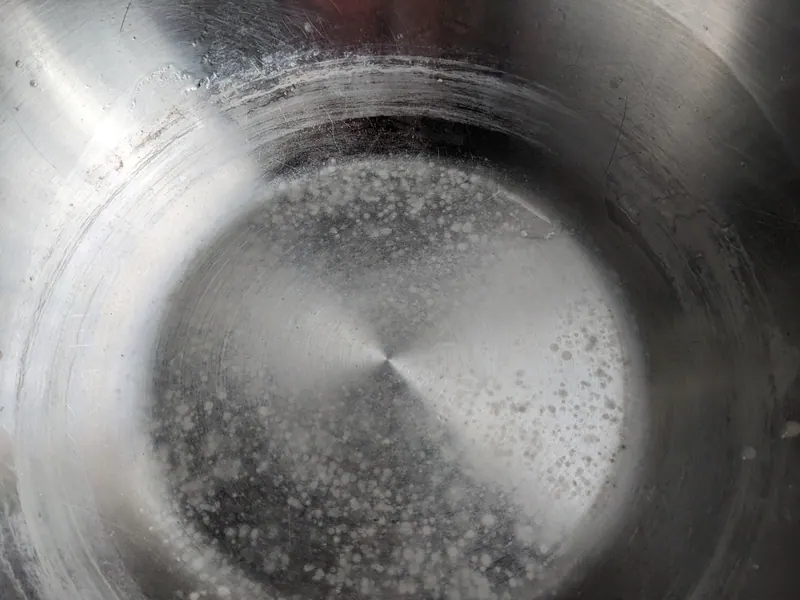
The same deposit that furs up a kettle dries onto shower glass.
Nicbou · CC0That is the gap in national cleaning advice. A guide written for the whole country describes limescale as something you tackle now and then. In Tower Hamlets it is a standing condition of the building.
The WD-40 trick, and why it looks like it works
WD-40 shows up constantly in shower cleaning videos, and it is the clearest example of a tip that convinces people through the wrong evidence.
There is no acid in the can
WD-40 itself rules the product out. Its FAQ says the Multi-Use Product is neither a degreaser nor a general cleaner, and describes what it is instead: a lubricant that displaces water and keeps rust off. There is no acid in it. Nothing in the can is chemically capable of attacking a carbonate deposit.
What the oil is actually doing
What it does instead is fill the rough, scaled surface with oil so the panel reflects light evenly again, and make water bead and run off rather than sit and dry. The glass looks better for a couple of weeks. The scale has not moved. It is now sealed under a film that the next person has to strip before any descaler can reach the mineral underneath. Oil in a shower tray is also slippery, which is a poor trade for a temporary shine.
Vinegar is right about the chemistry and wrong about the surface
Acetic acid dissolves limescale. That part of the folklore is correct. The problem is that “use vinegar” gets repeated as though a bathroom were one material.
Two makers, two opposite instructions
Hansgrohe and Mira give flatly opposite instructions, and both are real manufacturer guidance. They contradict each other because they are describing different plated and coated finishes.
Surface by surface
| Surface | What the maker or trade body says | What that leaves |
|---|---|---|
| Chrome and plated taps | Hansgrohe bans acetic, hydrochloric, formic and phosphoric acid and recommends gentle citric acid agents; Mira recommends a soak in white vinegar or lemon juice | Citric acid, the one acid both point to |
| Shower glass | The National Glass Association rules out abrasives and razor blades, and says never to leave water or residue sitting on it | Citric acid, a non-scratch pad at most, then squeegee dry |
| Marble, limestone, travertine | The Natural Stone Institute warns that lemon, vinegar and other acids may dull or etch calcareous stone | No acid at all, vinegar and citric alike |
Stone is common in the newer new build flats around Canary Wharf, and etching is not a stain you can lift. It is a change in the surface.
The practical conclusion is unglamorous: the care sheet for your own fittings beats any article, including this one.
What we would reach for
- Citric acid powder in warm water. It is the acid shower head makers actually recommend, you control the strength, and it rinses away clean.
- A cloth, not a spray bottle. Hansgrohe specifically warns against spraying cleaner at a fitting, because the mist gets into openings and gaps.
- Short contact times. Five to ten minutes on a shower head, then a thorough rinse through every spray mode.
- A non-scratch pad at most. Abrasive materials and razor blades are exactly what the glass guidance rules out.
- A squeegee, every day. Scale forms where water is left to dry. Removing the water is more effective than anything you buy to remove the mineral later.
The damage you cannot clean off
When the haze is in the glass, not on it
There is a point where limescale stops being a deposit and becomes damage to the glass itself. Minerals held against the surface corrode it, and the National Glass Association warns that glass can be permanently damaged if it is cleaned infrequently or improperly, and that water and cleaning residue should not be left sitting on it.
The shelf life of a shower screen
This is the honest reason we push prevention so hard in Shadwell, Limehouse and the Wharf. A shower screen in a hard water flat has a shelf life, and the daily squeegee is what extends it. The same mineral dries onto window glass, where cleaning windows above the ground floor turns a quick wipe into a job with its own rules.
What this means at the end of a tenancy
Bathrooms are one of the first things a check-out inspector examines, and limescale on glass, taps and shower heads is a recurring line in cleaning deductions. Ordinary build up over a tenancy is generally fair wear. Scale left long enough to block nozzles or cloud the glass reads as neglect, and by then nobody can clean it back to the check-in photographs.
If you are handing a flat back, the useful sequence is descale the shower head, treat the glass and taps with citric acid, rinse everything, then dry it all. Where scale has been building for years, that is bathroom work for a deep clean of the whole property rather than a wipe round. Dry surfaces photograph honestly. Wet ones dry into exactly the spotting you just removed.
The numbers, and where they come from
- London water is hard
- Thames Water classifies 200-300 mg/l of calcium carbonate as hard and above 300 mg/l as very hard, and states that all the water in its region is hard.
- Source
- No legal hardness limit
- The Drinking Water Inspectorate says UK regulations set no standard for hardness, calcium or magnesium. Hard water is safe to drink but it causes scaling.
- Source
- WD-40 is not a cleaner
- WD-40 states its Multi-Use Product is not a degreaser and is not designed to be used as a general cleaner. It is a lubricant, water displacer and rust preventative.
- Source
- Vinegar is banned by some makers
- Hansgrohe tells owners not to use cleaners containing hydrochloric, acetic, formic or phosphoric acid, and recommends gentle citric acid based agents instead.
- Source
- And recommended by others
- Mira, a British shower manufacturer, tells owners the best way to shift stubborn limescale is soaking the affected area in lemon juice or white vinegar.
- Source
- Descaling is minutes, not hours
- Hansgrohe instructs owners to soak a shower spray disc in citric acid descaler for about five to ten minutes, then rinse it thoroughly in every spray mode.
- Source
- Glass damage can be permanent
- The National Glass Association warns glass can be permanently damaged if infrequently or improperly cleaned, and says not to let water or residue remain on the surface.
- Source
- Acid etches natural stone
- The Natural Stone Institute warns that products containing lemon, vinegar or other acids may dull or etch calcareous stones such as marble and limestone.
- Source
Common advice that is wrong
- false
“A squirt of WD-40 takes limescale off shower glass.”
WD-40's own FAQ says the product is not designed as a general cleaner. Limescale is calcium carbonate, and a lubricant films over it rather than dissolving it.
Take the maker at its word. WD-40 lists the Multi-Use Product's jobs as lubricating, displacing water and preventing rust, and says it is not a degreaser and was never designed as a general cleaner. None of those jobs dissolves a carbonate deposit. The company, answering about headlights, warns that it leaves an oily film and no lasting result where clear visibility matters. A shower screen is the same problem. The oil fills the scaled surface so light reflects evenly and water beads away. The scale is still there, now sealed under a film that has to be stripped before any descaler reaches it.
Source: wd40.co.uk
- false
“White vinegar is safe on every tap and shower in the house.”
Vinegar does dissolve limescale, yet Hansgrohe warns against cleaners containing acetic acid and points owners to gentle citric acid agents instead.
Manufacturers disagree, which is why blanket advice fails. Vinegar is dilute acetic acid, and acetic is one of four acids, with hydrochloric, formic and phosphoric, that Hansgrohe's care guide rules out in a cleaner because they could cause considerable damage. Its alternative is a gentle citric acid based cleaner. Mira, a British shower maker, says the opposite: for stubborn scale it advises a soak in white vinegar or lemon juice. Both are real instructions from real makers. The Natural Stone Institute adds that vinegar may etch marble and limestone. Your own care sheet is what settles it.
Source: assets.hansgrohe.com
- partly true
“Lemon juice is just as good as a proper descaler.”
The chemistry is right. Hansgrohe recommends citric acid, but a lemon states no strength and no contact time, and Hansgrohe says to observe both.
The idea is sound. Citric acid dissolves limescale, Hansgrohe recommends citric acid based agents for its fittings, and Mira lists lemon juice as a way to soak scaled taps. The gap is control. Hansgrohe also tells owners to observe the dosage and exposure time the cleaner's manufacturer prescribes, and a lemon states neither. Strength varies fruit to fruit and you are guessing at the contact time. Citric acid powder in warm water is the same acid at a strength you set, and it rinses off clean.
Source: assets.hansgrohe.com
- true but risky
“Leave the shower head soaking in descaler overnight.”
Hansgrohe asks for about five to ten minutes in a citric acid descaler, then a rinse in every spray mode, and says not to leave cleaner on for long.
A long soak does shift heavy scale, but it is not what the maker asks for. Hansgrohe's instruction is to immerse the spray disc in a citric acid based descaler for about five to ten minutes, or for the time the descaler's manufacturer states, then refit the head and rinse it thoroughly in all spray modes. The same guide says not to leave cleaner on for a long time, and warns that on a surface which is already damaged, leaving it on makes the damage worse. Overnight is a long way past five to ten minutes.
Source: assets.hansgrohe.com
- false
“Cloudy shower glass just needs a stronger cleaner.”
Sometimes the haze is in the glass, not on it. The National Glass Association says infrequent or improper cleaning damages glass permanently. Then it is polishing or replacement.
Sometimes the haze is not sitting on the glass, it is in the glass. The National Glass Association's cleaning paper states that glass can be permanently damaged if it is infrequently or improperly cleaned, and tells you never to let water or cleaning residue remain on the surface, which is what a hard water shower does daily. Once glass is damaged, the paper puts the remedies at chemical cleaning or mechanical polishing rather than a spray, and it rules out abrasive materials either way, so a scouring pad only adds to it.
Source: glass.org
- false
“Vinegar and bicarbonate of soda together are the strongest limescale mix.”
Bicarbonate of soda is an alkali, so tipping it into vinegar uses the acid up. The salt solution left behind shifts less scale than the vinegar did alone.
The Royal Society of Chemistry's classroom notes on limescale removers put it plainly: calcium carbonate is virtually insoluble in water but dissolves readily in acids, and strictly it is reacting with them rather than dissolving. Bicarbonate of soda is an alkali. Tip it into vinegar and the acid gets used up. The fizz is carbon dioxide leaving, and what stays in the bowl is a salt solution that shifts scale less well than the vinegar did on its own. Bicarbonate paste is a mild abrasive, which is a different job. If you want acid, use acid.
Source: edu.rsc.org
What we see on the job
Every property we clean sits in the same water, from Canary Wharf out to Canning Town, so descaling is not an occasional extra for us. It is a standing item on two of our service lists: limescale removed in bathrooms on a deep clean, bathrooms descaled and polished on an end of tenancy. That is why we treat scale as a time problem rather than a product problem. There are six of us and you get the same cleaner each visit, so the person doing your shower screen already knows how quickly it comes back between cleans.
Common questions
Is London water genuinely hard, or is that a sales line?
It is genuinely hard. Thames Water classifies water between 200 and 300 mg/l of calcium carbonate as hard, anything above that as very hard, and says all the water in its region is hard. That is why scale returns on a Canary Wharf shower screen within days of cleaning it, while the same flat in Manchester would go months.
What is the safest thing to use if I rent and cannot risk damage?
Citric acid powder dissolved in warm water, applied to a cloth rather than sprayed at the fitting, then rinsed and dried. It is the acid shower head makers recommend, it leaves no residue, and it is gentle enough for chrome. Keep it off marble, limestone and travertine, and read your fittings' care sheet first.
Can etched or cloudy shower glass be brought back?
Not with a cleaner. If the minerals have corroded the surface, the cloudiness is in the glass rather than on it, and no spray reaches it. The options are mechanical polishing by a glass specialist or replacing the panel. This is why the honest advice is to keep the glass dry rather than to promise a rescue later.
How often should a shower head be descaled in a hard water flat?
Monthly is a reasonable rhythm in East London, and you will notice when it slips: the spray goes uneven or fans sideways. Many modern heads have flexible silicone nozzles you can rub clean with a thumb while the water runs, which delays a full soak considerably.
Does using a squeegee actually make any difference?
It is the single highest value habit in a hard water flat. Scale only forms where water is left to evaporate, and the National Glass Association advises against letting water or cleaning residue remain on glass. Thirty seconds with a squeegee removes the water before it can deposit anything, which beats any product you buy afterwards.
Will limescale cost me part of my tenancy deposit?
Normal build up across a tenancy is usually treated as fair wear. Scale left long enough to etch the glass or block the shower head is treated as a cleaning failure, and bathrooms are one of the first places a check-out inspector looks. Dealing with it monthly is far cheaper than arguing about it in a check-out report.
If you would rather we did it
We are a small cleaning team working across Canary Wharf and East London.
Deep Cleaning
Oven, behind furniture, limescale, skirting boards.
From £60
End-of-Tenancy Cleaning
Agent-ready finish so you get your deposit back.
From £100
Who is behind this
J&BROS Cleaning is run by Jerimiah, who owns the business. We are a small cleaning team working across Canary Wharf and East London, and these guides are published under his name. More about us .
Cleaning in East London
Same-day quote · fixed price